
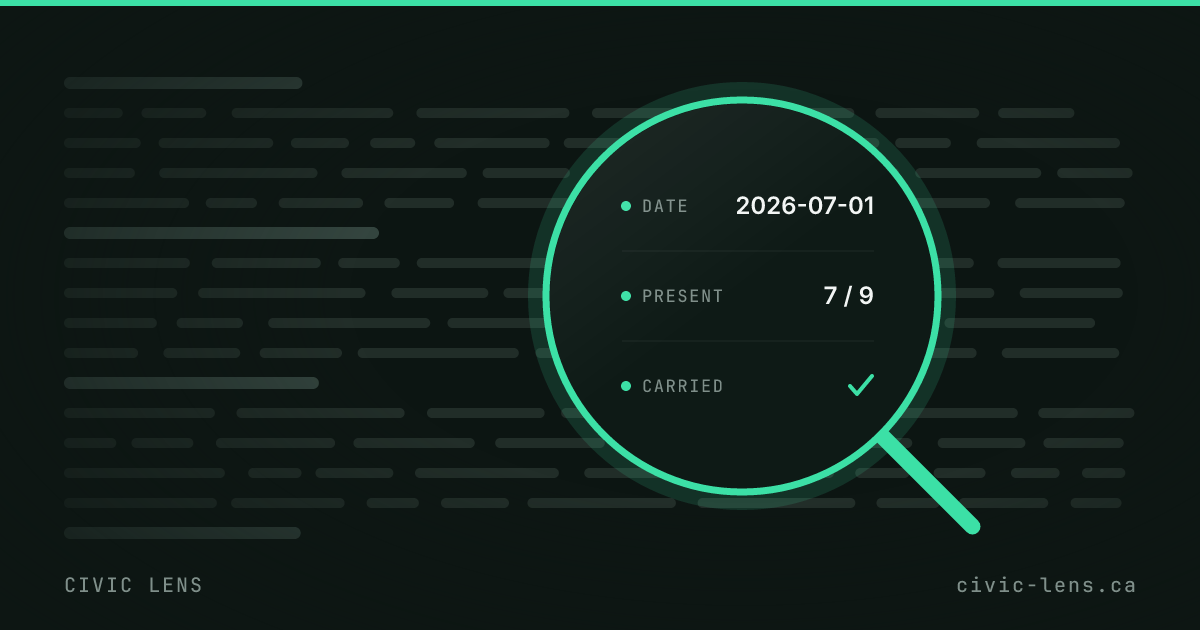
The public record is only useful if people can actually read it.
Civic Lens turns what your city already publishes into plain language you can search, understand, and verify against the original source.
- Cities on the record
- 874
- Council meetings (in 2026)
- 15,345
- Attendances recorded
- 55,780
What's in the database today (July 2026)
Public, but not readable
The decisions that shape daily life mostly get made close to home: property taxes, zoning, what gets built and what doesn’t, how the transit money gets spent. Councils make those calls in open meetings and (are supposed to) post the minutes afterward. Technically, the record is right there.
Try to actually use it, though, and it falls apart. It’s spread across hundreds of separate city portals, locked inside PDFs, and laid out differently in every town. You can’t search it. You can’t line up one city against another. And when someone tells you what council decided, there’s usually no quick way to go back and confirm they’re right.
What Civic Lens does
We collect council minutes from Canadian municipalities, read them, and pull out the facts — when a meeting happened, who was there, what was decided — as data you can actually read. Everything lands in one place, across cities.
From there you can search the whole record at once instead of one PDF at a time, set an alert for a topic you care about and hear when it next comes up in a meeting, or open a city to browse its council, its meetings, and the original documents each fact came from.
Why you can trust it
A clean, searchable fact is worthless if it’s wrong. So every fact we publish keeps a link back to the exact document version and page it came from. If something looks off, open the source and check it yourself. Also, please let us know with the link at the bottom left of every page 🙏.
Open and bilingual
This is public civic infrastructure. The data is meant to be read, quoted, and reused — whether you’re a resident keeping an eye on your council, a reporter chasing a story, or a researcher working with the numbers. The site runs in English and French (well… it’s AI-translated French because our team doesn’t speak French. We’re happy to fix anything that is off and apologise in advance for what we have done 😊).
What’s next
Minutes are where we started, and there’s plenty left to do with them. But the record is bigger than minutes.
City financials come next, so you can answer the basic question: where does the city spend my tax money? Alongside that, procurement awards — how much does one contractor get paid by your city in a year, and what did that new sidewalk actually cost?
Then bylaws and policies: the full life of a bylaw in one place — readings, adoption date, current status, and every amendment, including the ones from previous councils.
And a moonshot. We’re in early conversations with a few cities about letting confirmed residents weigh in on what’s happening in their neighbourhood. Call that one a maybe.
Is there something you want to know about your city that isn’t here yet? Tell us — we’ll do our best to make it available.
What this blog is for
We’ll use this space to write about the work: new cities and sources as they come online, the messy details of getting a fact off a PDF page and into a database, and the engineering calls we make, including the ones we get wrong the first time. We’ll also dig into the data itself and share what we find: the councillor who expenses the most brunch, the city with the most time-efficient meetings, that kind of thing. Same rule as the rest of the platform — when we cite something, we point you to where it came from.